
A ‘Pretty Good’ Frontman: In-Depth with PGSU's Tobias Prey

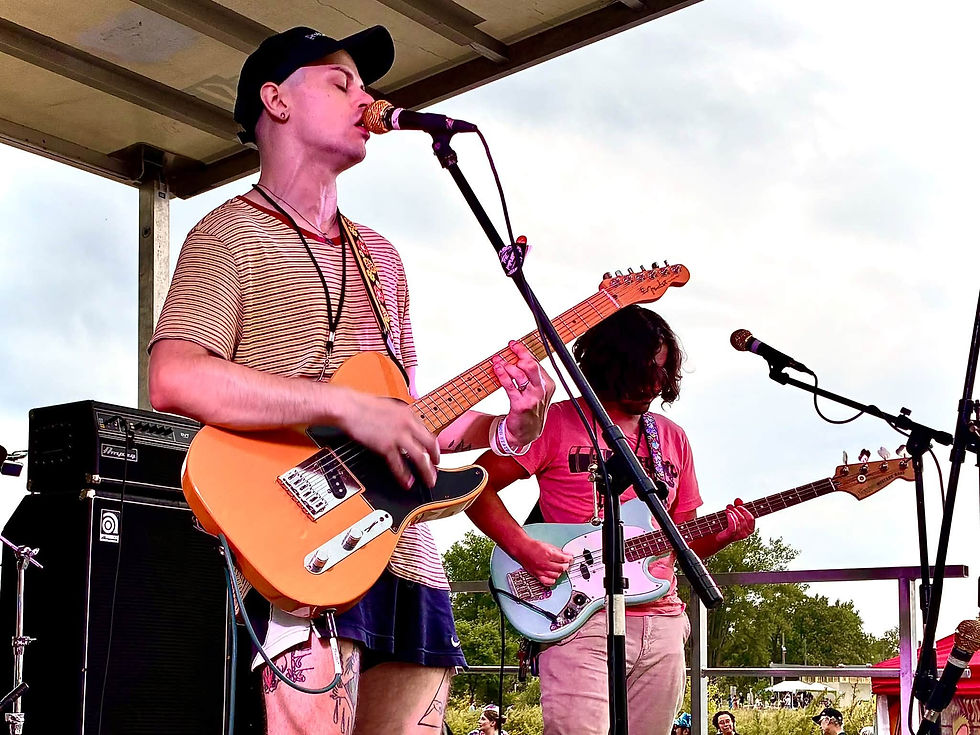
(EDITOR’S NOTE — There’s a difference between ripping through a set and putting on a show. Pretty Good State University is known for doing both every time it takes the stage and its frontman Tobias Prey is one of the most engaging frontmen on the Buffalo scene. Recently, he sat down with 1120 Press, and we thank him for his time. — Photos and video by Matt Smith/1120 Press)

1120 PRESS: Thanks so much for speaking with us. There’s a lot to talk to you about but let’s start with what you’re most widely known for: being the frontman of the punk band Pretty Good State University. We’ve been long intrigued by your showmanship and we’re wondering whether that’s a reflection of who you’ve always been going back to when you were a kid you, or whether you just transform into someone else entirely when you’re on stage?
TOBIAS PREY: Yeah, as a kid, I was very curious, first and foremost. You know, a lot of parents love to hit their kids with that line: ‘Because I said so.’ And my mom was very adamantly against that. She would let me question her to kingdom come, and she would let me argue with her, and let me change her mind about stuff. If I could give her a good solid argument, she would be willing to listen. And so, in that way, I was very encouraged to be very curious and to push boundaries constantly. And I liked being the center of attention. I liked to make people laugh. So, the way that I am on stage is no different than who I am as a person, but at the same time, it's cranked up because it's allowed to be. I can really let the mask and leash off in a way that I can't in any other space. And I think that's what has always appealed to me about music in the first place. From a very young age, I recognized the freedom that came with being a musical performer and how that was different from any other sort of performance.
I wrestled for a little while, like some amateur stuff here in Buffalo. Shout out ‘Nickel City Wrestling.’ Pro wrestling was the first thing I ever loved as a kid. But wrestling is very collaborative in a way in which you’ve got to keep each other safe, and you've got to tell a story that the crowd buys into. With music, though, the thing that I like most is the freedom that comes with it compared to other kinds of performance. It’s like, you give me this microphone, and I can do whatever the fuck I want with it for the next 25 to 45 minutes, as opposed to if I'm acting, I have to do what the director wants, and I have to serve the scene. Punk rock was always an ethos that appealed to me because it’s built on this idea of radical acceptance that people should be allowed to do whatever the fuck they want as long as it's not hurting anybody. I'm an audience of one, always. (PGSU lead guitarist) Vinnie (Lema) is that way, too, and I think that's why he and I mesh so well. Everything we do is always done from this approach. And if you want to hop on and come along for the ride — awesome! You're more than welcome. We want to make you feel safe and comfortable being on that ride. But if you're not into what we are doing, well, your opinion doesn't matter to me. And I don’t mean that in some crass, arrogant way. I just don't waste a lot of my time thinking about what other people want out of my art because it's not theirs, it's mine.
1120: Were you the class clown growing up?
TP: I was not the class clown so much as I was like the class combatant. I definitely was a clown and made people laugh, but I grew up in a small town. I grew up in Arcade, New York. It's a real rural area. And a lot of kids never, ever stopped to challenge anything. You know, they were like nine generations deep on the family farm. And, hey, I get it. It's part of the culture out there. But I was this very rambunctious and curious kid, and nothing thrilled me quite like antagonizing people. And the way I antagonized was to poke at them and ask them a billion questions about religion and about conservative values and family values… That's always the edge that I've kind of skated on. ‘Hey, I'm going to push things as far as I can because that's what's entertaining for me.’
1120: That's interesting because in a way it bleeds into our next question which has to do with your approach to songwriting. You have this knack for taking serious and complex issues and injecting a sense of simplicity and humor into those issues without watering them down. Does the way in which you grew up challenging the status quo — and the fact that you majored in philosophy — influence your approach to songwriting?
TP: Yeah, I think it influences the approach in all my writing. I want whatever I write to be accessible. I'll get a lot of hate for this, but I despise David Lynch. And a big part of the reason is because he played this very esoteric character in which he was like: ‘My art is beyond interpretation.’ Fuck that. Art means something, and I refuse to let mine be interpreted. I want it to mean what it means, and so I want it to be accessible. Ultimately, I recognize you can't guarantee that, right? But I don't want the message in my art to be lost on anyone. I loved writing as a kid, and I write a lot of poetry. I write short stories. I work on larger projects. And for me, I want anything that I write to feel like a conversation. I want my writing to feel like I'm talking through my work and communicating with people. I'm a very semantic guy, and I think that influences how I communicate across the board. And I don't write for an audience necessarily but if there’s going to be an audience, I don't want my message to be lost.
1120: At what point in your life did you start steering yourself toward music?
TP: Music was something I really loved as a kid. First thing I wanted to be was a rock star. Like I talked about earlier, the freedom of making music for me is I can just do whatever I want with the art. There was a time when I was doing Headspace, my project before PGSU, and it was just me with an electric guitar. There was a freedom in knowing I could make whatever kind of art I wanted. But in school, with chorus, I hated singing those songs. And it just like made me dread doing this thing that I had always loved. So, I quit doing chorus, and around the same time — fucking puberty, dude, what a time in people's lives — I was already just feeling a little weird about my voice changing. I still loved to sing, but it turned into a thing that I in did the shower, and it turned into a thing that I did alone in the car, and it turned into a thing that I did when I was alone, instead of like being a thing that I thought I could do in front of people.
Then I was in college, I met a lot of friends who were in bands. I was writing then. I was visiting a buddy, and he was working on a song with another one of our friends and they had like this really cool riff. I helped write the lyrics and I was just like, ‘Oh, this is awesome, man. This is really, really cool.’ I had an old acoustic guitar at home that I tried learning a little bit. I thought it would be a funny bit to learn ‘Wonderwall’ before I went to college. So, I learned enough of Wonderwall to be able to do my bit and that was it. But after doing that and writing that song with my friends, I was just like, ‘I'm going to go home learn how to do this. I'm going to learn as much as I need to learn on guitar to be able to facilitate writing songs.’ And I think that's part of the reason why there's that air of simplicity to a lot of our earlier stuff. A lot of it was necessity. I wanted to be making music, and I was limited on guitar. If you listen to that first Headspace EP — which only exists as Headspace on Apple Music now — all those songs are three or four chords max.
1120: So, when you reflect on your musicianship and your songwriting, how do you think you have evolved?
TP: I think I'm a lot more confident, and proud of what I produce nowadays. But I also

think that having had a sense of like, ‘I'm really proud of this thing that I made,’ now gives me a new standard that I didn't really have before. It’s not stifling, but I do think it kind of narrows the scope of what was this unbridled creativity. And I find that both frustrating and very uplifting. It turns each new creative endeavor into a new kind of mountain. But also, now there's this element of like, ‘I don't want to just force something. I want to make it as good as I think it could be.’ And that’s exciting. I think it's the difference between a 5-year-old finger painting and an art student putting something in their portfolio.
1120: Is that confidence that you now feel what gave birth to your new solo project, ‘Shelley Duvall Cigarette’?
TP: I think so. Shelley Duvall Cigarette is a lot of early songs that I always had an affinity for, and it’s been a place to put stuff that I've been playing around with. I'm very proud to have carved out the niche that we have with Pretty Good State University. I’m not trying to toot our own horn, but it’s bigger than I ever expected that it would be when we started doing this. And that's cool to me. It means a lot to me. But it also does create a sense of integrity that I feel for that project. I want to make sure we meet a standard with Pretty Good State University. With Shelley Duvall, it's: Here are some songs that I like but that I feel would dilute what we're doing with Pretty Good State University.
There are certain songs that I write — for instance, I have a song called ‘The Sad Song’ which I wrote last year — and that's a song that I'm really proud of. I love it. But it's just me whining about my own depression, and there's not this happy resolve to it. It's just me being like, ‘Hey, sometimes I feel really depressed and beaten down. The end.’ I don't think that fits the ethos of PGSU, and I don't want to undermine that ethos at all. With PGSU, we are going to make sure you're aware the world's not all fucking roses and butterflies. We're going to hold your eyes open ‘A-Clockwork-Orange’ style, but at the end, we're going to remind you, too, that it's all okay and we're going to get through this shit together. We have each other. We can make each other laugh. We can come together and make some loud-ass rock and roll, and that's gonna get us through, you know? I don't ever want to make PGSU the ‘All-About-My-Feelings Project.’ But that said, I do have songs like that that I'm proud of and they are ‘Wah, Wah, Wah my feelings,’ and so Shelley Duvall kind of exists for that.
1120: You debuted Shelley Duvall with a set at the Music is Art festival this year, right after your performance with PGSU. We’ve seen you perform a lot, and your set with PGSU that day was one the best performances we’ve seen by you. How do you think you've developed as a frontman?
TP: I think as far as being a frontman that’s probably the part of getting into the scene that I was most comfortable with from the jump. I think there's this combination of unwarranted blind confidence that I've always had, and being willing to throw myself in with a complete lack of embarrassment. As I've stuck with it, and really kind of paid attention and developed as a performer, how often PGSU’s stage presence is brought up is something that I'm very, very proud of. That's something we care about a lot, and we put a lot of thought into — not in some coordinated way, but in a way where it's just like, ‘hey, we want to put on a show.’ As I've gotten more confident, the connection I’m able to have with an audience is something that's just kind of magical.
1120: PGSU is writing new material. You have a new song coming out soon and you're also writing more material beyond that. What can you say about the new song, and what is the long-term plan for all the music you guys are writing right now?
TP: So, as far as the new song, what I can tell you is it's ‘pretty good.’ It's a ‘pretty good song.’ That's what I've got to say about that one. We're very excited. It was the most fun we've ever had making music together, putting that one together. And I think in the recordings and the demos that we've been tossing back and forth, you can really hear that. I think that if there was a song that we've recorded that feels like being at a PGSU show, it’s this song. And so that's what I'm most excited about.
Beyond that, we are currently working on a few new songs as well as some re-records of songs that were on my debut under the banner of Headspace. Some of those songs have remained in our current rotation with PGSU and so we wanted to give them new life. And then, we have some new ones that are PGSU originals. So, I think we're looking at like six, maybe seven, new songs that will be on this EP. We're excited and eager to put this new stuff out. The goal is to have new stuff out early next year.
1120: And these were produced by (PGSU drummer) Noah Logan and recorded in his home studio, right?
TP: Yeah. Noah is such an incredibly interesting character. I love Noah to tears, endlessly. He's a really good musician, a great drummer — he's just really good everything. I had sent him just a voice memo of the new song — the single we have coming out — back in June or July. In fact, I sent it to all the guys in the band. Nobody ever responded to it, which happens sometimes. And so, I just kind of thought, ‘OK, nobody really likes it, right? That's fine.’ So, I came back to it, put some music to it this time, and I was like, ‘hey, what do you guys think of this one?’ And still, there was no response to it. But then after Music Is Art in September, Noah said to me, ‘I really like that new one. That's a pretty good song.’ Then he texted all of us a couple weeks ago and said, ‘Hey, can you guys come into the studio next week on Friday?’ So, we did, and he was like, ‘check this out.’ He had put together the whole demo for the new song from top to bottom. So, he had me and Vinny come in, and Vinny got his rhythm in and got his lead tones in. And I threw down rhythm and threw down my vocals. It was that simple. Noah’s just such an incredible guy to work with, and on top of that he’s a genuinely nice and kind human being.
1120: And how is it working in PGSU now with Blaise Przybyla — (of BP & The Oil Spills and Gulf of Mexico Productions) — who has taken over on bass since Clayton Duffy moved away?
TP: Blaze is the pinch hitter. We've known Blaise for a while. He started booking us back when I was doing Headspace. He was one of the first connections I made in the scene, and I always really liked BP & the Oil Spills. I thought they were a really great band. I still do. We've just known him and have been friends with him for a while, and so, once Clayton stepped out, we were like, ‘What do we now?’ I don't know that we thought Blaise would actually do it, but we thought it was worth asking him. And he was like, ‘Yeah, you know, that'd be cool.’ So, he's played bass for us, and he's played drums for us when we've needed him when Noah isn’t available, and so I think we very much consider him a part of the band. And Blaise is a great drummer, but drums are also like his third instrument. Yet to his credit, Blaise has kind of been thrown to the wolves and he’s been there for us in whatever way we’ve needed him.
1120: Will there be any releases coming from Shelley Duvall Cigarette in the near future?
TP: I would like to release some songs. A lot of it depends on Noah's availability, and he just had a real busy summer. But we're talking about getting some stuff done over the next couple months throughout the end of fall and into early winter. I've got a catalog with probably five or six songs that I’d really like to put out. So, yeah, it's something I definitely am hoping to pursue.
I had a very busy summer this past summer. I got to spend a lot of time with friends. My best friend got married, which was awesome and I got to be in the wedding and that was terrific. But I just had a lot of things that were kind of taking up a lot of my bandwidth over the last four months or so. And so, it's been really nice to just kind of decompress a little bit and kind of regain the motivation to pursue creative endeavors, and not so much force myself to do them.
In the meantime, PGSU has a small slate of shows coming up throughout the rest of this year. We're playing this Saturday (Oct. 31) at BJ's in Fredonia for Halloween. We're going to be playing Mohawk's Christmas party December 18. And we also have a showcase at Mohawk, I believe, on December 10. You can quote me on that, but it doesn't mean I'm right.
1120: Thanks so much for speaking with us and good luck with everything you have going on. Before we wrap up, is there anything else you want to add?
TP: Yeah. Make sure you vote next Tuesday. Make sure to eat your vegetables, and just be kind to one another, man. Like, you can hate on people and still be kind. Vinny and I do it all the fucking time. I think that's it.


Comments